Comfort, light, and energy that hold up across thousands of small-format sites.
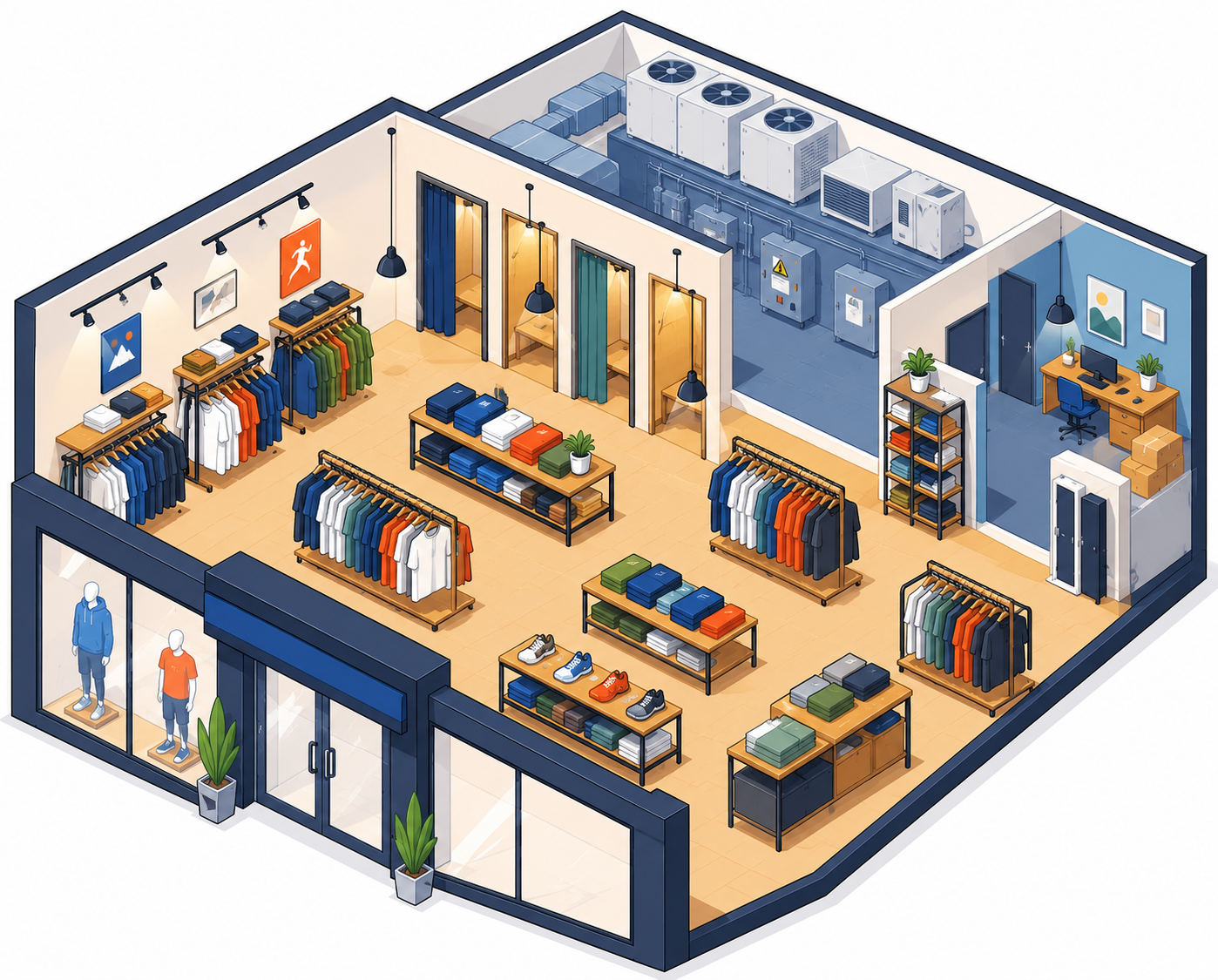
Productization for small-retail chains — apparel, beauty, and specialty banners (clothing, cosmetics, accessories, and similar). Small store footprint (500–8,000 sq ft), simple building infrastructure, no refrigeration load, and customer comfort as the primary operational objective — customers spend significant time browsing, making climate control critical. Keedian covers three asset domains: HVAC (RTUs and store HVAC — the dominant asset class), Lighting (interior, exterior signage, back-of-house) and Energy (site-wide electric and gas). Built for chains where in-house facilities support is limited, store staff are operations people (not facilities), and internal expertise on building systems is generally low.
- Energy savings — Up to 30%, combined across HVAC, Lighting and Energy
- Avoided truck rolls — Up to 60% fewer reactive dispatches across unattended sites
- Asset lifespan — Up to 20% longer useful life on HVAC and lighting fixtures
- Customer experience — comfort and ambience consistency across every site
Portfolio ceilings — expected (pending validation). Per-product quantitative ranges live in each product page's Expected outcome row.
Pick a product.
Each Keedian product targets a specific asset in your store. Click a card to open the product page.
HVAC Comfort & Optimization
Asset: Rooftop units (RTUs) and store HVAC serving sales floor and back office.
Lighting Control & Optimization
Asset: Lighting circuits — sales floor, exterior signage, back-of-house.
Energy Intelligence
Asset: Site-wide energy consumption (electric, gas).
This page covers the standalone format — small-retail chains that operate their own buildings and control the full lighting footprint, from sales-floor circuits to exterior signage.
Executive summary
Impact: Expected (pending validation) lighting energy savings of 1–3% of total store energy through schedule discipline and off-schedule auto-revert at Managed, rising to 2–4% plus burn-hour-driven lamp-life planning at Optimized — higher on the lighting load itself. Per-tier ranges in the Expected outcome row below.
What it solves: Lights left on after close, exterior and signage circuits running mid-day, dark spaces a customer notices before you do, lighting energy spend that drifts across a distributed footprint, and off-schedule run-hours no small-team owner can manually police.
The metrics you'll want to optimize.
These are the operational metrics the product monitors. What changes across tiers is who acts on them — you (Essential), Keedian's Agentic Operations (Managed), or Keedian plus continuous tuning (Optimized) — and, where the data layer adds instrumentation, which signals become available.
The core metrics are summarized below. Full methodology, thresholds, diagnosis steps, and escalation criteria are in the Metrics Catalog.
The percentage of time each lighting circuit's on/off state matched the agreed schedule for its space. The primary discipline indicator for lighting — unlike HVAC, where comfort can excuse non-compliance, lighting run against schedule is almost always pure waste.
Full detail → Metrics CatalogThe percentage of time circuits were actually on, averaged across the spaces in scope. Where Schedule Compliance asks whether the lights followed the rule, utilization asks how much they were actually used — most useful for spaces with no fixed schedule, where it exposes a stuck sensor or a failing circuit.
Full detail → Metrics CatalogAverage hours per day each circuit was on — the absolute version of utilization. Kept as its own metric because it drives lamp-life prediction (LEDs are rated in hours) and utility-rebate validation (efficiency rebates are conditional on minimum burn hours).
Full detail → Metrics CatalogEach metric includes definition, detection logic, diagnosis steps, recommended actions, escalation criteria, and prevention controls. Thresholds are reference values to be calibrated per client.
View Metrics Catalog →Three accumulative tiers.
Each tier adds capabilities on top of the previous one. You never lose functionality by upgrading, and you can start at any tier.
- Energy savings: Visibility / foundation
- Asset lifespan: Foundation
- Sustainability: Off-schedule run-hours made visible
- Energy savings: 1–3% of total energy (expected, pending validation)
- Asset lifespan: Foundation
- Sustainability: Eliminated off-schedule run-hours, evidenced
- Energy savings: 2–4% plus lamp-life extension (expected, pending validation)
- Asset lifespan: Burn-hour-driven lamp-life planning
- Sustainability: Sustained reductions, proof for rebates and reporting
- Per site: a lighting control + metering node at the panel — a smart relay/contactor with per-circuit current sensing (CT) and scheduling, covering the ~3 circuits (sales floor, exterior/signage, back of house)
- One connectivity gateway per site (covers all monitored circuits; shared with HVAC, Refrigeration, or Energy if those products are also contracted)
- Per-circuit submetering / power-quality sensing on circuits that need equipment-health depth — real power and current per circuit for lamp-driver and ballast health
- Additional optional sensors evaluated per site profile — photocell / ambient-light sensor for exterior and signage circuits, occupancy sensing for back-of-house spaces, dedicated CT per circuit for rigorous burn-hour and rebate validation
- Site and portfolio dashboardsReal-time and historical visibility into the assets and metrics included in scope, with live alarms where applicable
- Cross-site benchmarking with outlier detectionSee which locations drift from the fleet
- Ticket workspaceAlarms auto-filter into a managed queue that you and your team work yourselves: triage, resolve remotely, or dispatch on each ticket
- Conversational AI AssistantNatural-language questions on your data plus automated anomaly detection across the fleet
- Lighting Remote CommandSwitch circuits on or off and push lighting schedules to one site or the whole fleet
- And moreRole-based access, alarm history, data export, web and mobile parity
- Everything in Essential
- SLA tracking and service performanceLive SLA compliance against contractual targets per priority level
- Standard CMMS integrationOut-of-the-box connectors for Fexa, Corrigo, ServiceNow and others; custom field maps or workflow adjustments may apply depending on your configuration
- And moreClosure evidence on every ticket, weekly ops digest, post-incident reviews
- Everything in Managed
- Advanced Lighting Predictive metrics (roadmap — coming later)Circuit-level health and early-warning indicators (driver/ballast degradation, lamp end-of-life, failing controls), evolving toward fleet-wide forward-looking views
- And moreCross-site benchmarking with savings ranking, custom optimization rules, executive briefing reports
- You and your team manage alarms, tickets, and remote commands yourselves from the dashboards
- Real-time alarm and ticket monitoring — Alarms and tickets generated from the assets and metrics included in scope are monitored, triaged, and worked by Keedian agents in real time, in accordance with the agreed operating procedures and escalation paths AI
- Reactive site requests — Sites can reach Keedian on any channel; our AI evaluates each request and opens a ticket when one is warranted — a fault, a setpoint-change request, or a question — feeding it into the same triage-and-resolve workflow AI + Human
- Reactive CMMS intake — Tickets triggered by the customer's CMMS are ingested and routed into the same triage-and-resolve workflow, with our AI evaluating and enriching each one AI + Human
- Remote resolution first — Every ticket gets a remote-resolution attempt by Keedian Ops before a truck roll is scheduled, with the avoided truck rolls counted toward the Managed-tier ROI report AI
- Field dispatch when needed — Keedian Ops creates the work order, hands off to the customer's CMMS, and tracks resolution against SLA Human
- Root cause analysis on close — Every closed ticket includes a documented root cause and the corrective action taken, feeding into recurring-failure detection AI
- Recurring-failure detection — Sites or units with repeat tickets are flagged for replacement or vendor escalation, with the recurrence pattern surfaced in the monthly executive report AI
- Everything in Managed, plus
- Predictive ticket origination (roadmap — coming later) — AI and multi-variable FDD logic use the assets, metrics, baselines, and predictive signals included in scope to open and work tickets for emerging fault patterns before a conventional alarm or customer report AI
- Additional Lighting FDD coverage — Analytics-driven fault detection on Schedule Compliance, Utilization, and Burn Hours is fully worked by Keedian Ops, aligned with the advanced and predictive lighting metrics dashboards in Platform Capabilities AI
- Portfolio lighting compliance report% of sites in compliance for each lighting optimization metric (Schedule Compliance, Utilization, Burn Hours) for the period, with monthly trend per metric
- Site lighting reportPer-site schedule compliance, utilization by space, and burn hours with compliance flags, all with monthly trends
- Lighting alarm and ticket volumeMonthly off-schedule, utilization-out-of-band, and lamp-life alarms, tickets generated, and alarm-to-ticket conversion across the fleet
- Top alarm and ticket sourcesRanked list of sites and circuits generating the most lighting alarms and tickets
- Everything in Essential
- SLA & MTTR performanceSLA compliance against contracted targets per priority level, with Mean Time to Resolution by priority for fleet and per-site, and monthly compliance and resolution-time trends
- Reactive ticket activityReactive lighting tickets received (site calls, CMMS, customer-initiated) categorized by type, with the reactive vs proactive cross-analysis including the % Keedian proactively initiated
- Auto-revert and remote-resolution reportOff-schedule circuits returned to schedule automatically and tickets resolved remotely without a dispatch
- Managed-tier ROI reportLighting energy recovered through schedule discipline plus avoided lamp-out dispatches, monetized
- Off-schedule and lamp-out summaryBy site, by space: off-schedule circuits, utilization outliers, and lamp/ballast failures, with resolution time and root-cause distribution
- Everything in Managed
- Predictive alarm and ticket reportLighting faults caught proactively by predictive models (driver/ballast degradation, lamp end-of-life, control faults), with prediction accuracy and lead time before operational impact
- Optimized-tier ROI reportManaged ROI plus lamp-life extension from burn-hour-based group relamp planning and the energy from tighter schedule discipline
- Outlier deep divesQuarterly analysis of bottom-quartile sites with root-cause analysis and recommended interventions
- 99.5% monthly platform availability (UI, API, alerting)
- SLA by event priority (P1–P5)
- Monthly compliance reporting
- SLA from Managed
- Quarterly energy savings target with shared accountability
- HW provision base (gateway): Price per site
- HW provision per circuit (sensor pack): Price per Circuit
- Installation & commissioning: Price per Circuit
- Subscription: Price per site per month (up to 5 circuits/site)
- No HW provision, no installation
- Integration: Free or paid — depends on integration scope (open-protocol lighting control is typically free; proprietary lighting systems are quoted at SOW)
- Subscription: Price per site per month (same as Model A)
- Integration: Same as Model B — free or paid based on integration scope
- Subscription: Price per site per month (same as Model A)
- Everything in Essential
- Subscription: Price per site per month
- Subscription: Price per site per month (same as Model A)
- Subscription: Price per site per month (same as Model A)
- Everything in Managed
- Subscription: Price per site per month
- Subscription: Price per site per month (same as Model A)
- Subscription: Price per site per month (same as Model A)
Adjacent capabilities, on top of any tier.
Add-ons activate on top of any tier and any Data Enabler model. Each is either Domain-specific (within a product domain) or Transversal (across any contracted product). Open an add-on for its hardware, value levers, and pricing — or browse the full add-ons catalog.
Domain-specific
Adjacent capabilities within the product domain. Hardware and pricing live on each add-on's page.
| Add-on | What it solves |
|---|---|
| Emergency Lighting Compliance | Auditable monthly self-test reporting, battery health monitoring, and code compliance evidence (NFPA 101, OSHA) for emergency egress lighting. Replaces manual monthly walkthroughs. |
| Exterior Lighting Photocell Control | Astronomical clock + photocell-driven control of parking-lot, canopy, signage, and facade lighting. Eliminates manual schedule updates for daylight savings, seasonal shifts, and regional variation across the fleet. |
Platform-wide
Transversal add-ons that apply across any product you contract, charged once per site.
| Add-on | What it solves |
|---|---|
| BMS / EMS Integration Extension | Extend the integration to additional systems not included in the product's base Model B. |
| Custom CMMS Integration | Deep integration with your CMMS beyond the standard. |
| Data as a Service | Programmatic access to Keedian's normalized operational data for your analytics, BI, or data lake. |
| Ad-Hoc Dashboards & Reporting | Custom dashboards and one-off reports built to your spec, on top of the data Keedian already collects. |
An advisory layer, not a tier.
Tailored work for needs outside the standard packaging — scoped and priced per engagement, on top of any product and any tier. Keedian owns the connectivity and data layer; the physical asset stays with you and your vendors. Browse the full advisory catalog.
| Advisory element | What it solves | Type | Domain |
|---|---|---|---|
| Ad-hoc Solution Definition | Scoping and definition of ad-hoc solutions for needs not described in the standard tier model. | Transversal | All products |
| Field Services | On-site work on the connectivity layer — sensor calibration, gateway and smart-thermostat installation, integration validation — plus coordination of your HVAC vendor for asset repairs. | Transversal | All products |
| Sustainment | Post-deployment maintenance of the Keedian layer — sensor recalibration, firmware updates, hardware replacement, and periodic integration validation. | Transversal | All products |
| Customer-specific SOPs | Bespoke operating procedures — vendor-specific dispatch rules, regional escalation matrices, pre-dispatch approval workflows, and brand-aligned site communication scripts. | Transversal | All products |
| Custom Reporting | Bespoke executive and operational reports built to your specification on top of the data Keedian already collects. | Transversal | All products |
| One-off Integrations | Bespoke integrations with proprietary systems or clouds for which Keedian has no standard connector. | Transversal | All products |
Pricing: project-based · scoped per engagement
A hybrid of AI agents and human operators, working as one service.
The Managed and Optimized tiers are delivered through Agentic Operations — AI agents and human operators working together against the same operational rules and the same SLA.
AI agents handle the routine, high-volume work. They monitor schedule compliance, utilization, and burn hours in real time across thousands of circuits, auto-revert off-schedule circuits to their scheduled state, detect lamp, ballast, and driver degradation from current and power signatures, flag circuits running outside their expected band, plan group relamps from accumulated burn hours, identify outlier sites in a fleet of thousands of similar locations, draft work orders with the suspected root cause, and verify closure with telemetry evidence. They work 24/7 against the schedules and standards you set.
Human operators handle the exceptions. When an off-schedule event needs a conversation with the store manager, when a schedule change needs customer approval before acting, when a vendor escalation needs a human voice on the phone — that's the human side of the team. Operators also manage the customer relationship, refine the operating rules over time, and own the outcome reporting.
One service, one SLA, one accountability. The split between AI and human is invisible to you — you call Keedian, you read Keedian's reports, you measure Keedian against the contract. The internal mechanism evolves as the agentic stack matures; your contract does not change with it.
We capture lighting signal wherever it lives: our control node, your lighting controls, or both.
The Data Enabler is how the operational signal enters Keedian. We respect the investment you've already made in your lighting controls — if you have a working networked lighting control system, we connect to it. If you don't, we install hardware. If you have partial coverage, we fill the gaps. The managed service, dashboards, SLA, and outcomes are identical across all three models.
You don't have networked lighting control — or what you have isn't producing usable per-circuit data. Common in small retail running on manual switches, wall time clocks, or standalone photocells.
- Per site: a lighting control + metering node at the panel — a smart relay/contactor with per-circuit current sensing (CT) and scheduling, covering the ~3 circuits
- One connectivity gateway per site (shared with HVAC, Refrigeration, or Energy if those products are also contracted)
- In Optimized tier, per-circuit submetering / power-quality sensing is added on circuits that need equipment-health depth. Additional optional sensors available per site profile (photocell / ambient-light for exterior and signage, occupancy for back of house, dedicated CT for burn-hour and rebate validation)
- Installation included in the setup
- Setup: $0/site (install designed for fast multi-site rollout)
- Per circuit: $0 (Essential/Managed) or $0 (Optimized, with submetering)
- Standard recurring
Your lighting control exposes data through open protocols: BACnet, DALI, 0-10V, documented REST APIs. Acuity nLight, Lutron Vive / Athena, Tridium, modern networked lighting platforms.
- Integration through Keedian's standard connectors (already built and reusable)
- No Keedian hardware (or minimal if specific circuits are unmetered)
- Integration cost absorbed by Keedian
- No setup, no per-unit hardware
- Recurring +$3/site/month vs. Model A
- 3-year minimum contract
Your lighting control uses a legacy or closed system without modern APIs and requires a vendor gateway: legacy Lutron Quantum, WattStopper / Hubbell, Encelium.
- Custom integration built by Keedian (initial vendor-gateway work, then reusable across customers with the same system)
- No Keedian hardware (or minimal if specific circuits are unmetered)
- Integration cost absorbed by Keedian
- No setup, no per-unit hardware
- Recurring +$5/site/month vs. Model A
- 3-year minimum contract
You have partial coverage: networked controls on some circuits but not all, recent acquisitions running different systems, or controls in a subset of stores.
- A blend of Models A and B
- Uses existing controls data where it exists
- Adds the Keedian control + metering node where coverage is missing
- Scoped per site based on coverage
- Setup and per-unit charges only on circuits that need Keedian hardware
- Intermediate recurring
System classification
Maintained by Product + Engineering. Lets Sales quote on the spot without engineering scoping. Classification is pre-assigned per system; any system not on this list requires Engineering review before quoting.
- You don't have networked lighting control installed
- What you have produces poor per-circuit data quality
- You prefer the Keedian control + metering node end-to-end
- BACnet-enabled lighting control
- DALI networks with documented gateway
- 0-10V dimming via documented controller
- Acuity nLight (modern, API-enabled)
- Lutron Vive / Athena (modern API)
- Tridium / Niagara lighting modules
- Legacy Lutron Quantum (older versions)
- WattStopper / Hubbell legacy
- Cloud-only platforms without documented API
- Encelium (legacy versions)
- Custom-built panel control stacks
Why the structure is built this way.
Lighting is commandable, like HVAC
Lighting circuits are controllable, not just observable — an off-schedule circuit auto-reverts to its scheduled state rather than waiting for a site visit. Essential includes Lighting Remote Command for exactly this reason. The operating model mirrors HVAC: the platform sees the circuit, and where controls allow, it acts on it.
Per circuit, not per site
Lighting variable pricing is per circuit because circuit count varies across small-retail formats — a single-storefront apparel store may run 2 circuits, a larger format with separate signage and stockroom feeds may run 5+. A standalone small-retail store typically has about 3: sales floor, exterior/signage, and back of house. Per-circuit pricing scales fairly with both customer value and Keedian effort.
Energy is real but secondary to HVAC
Lighting is a meaningful operating-cost line, but smaller than HVAC for a small-retail store. The savings are conservative and currently expected (pending validation) — there is no lighting anchor customer. Managed-tier schedule discipline lands roughly 1–3% of total store energy (higher on the lighting load itself); Optimized adds burn-hour-driven lamp-life planning on top. We do not lead with a savings headline we cannot yet defend.
Truck-roll avoidance is minor for lighting
Unlike HVAC, lighting does not generate a steady stream of avoidable emergency dispatches. The truck-roll lever is narrow: remote auto-revert removes the after-hours-lighting reset visit, and accumulated burn hours let failing lamps be batched into a planned group relamp instead of repeat lamp-out calls. We treat it as a supporting benefit, not a headline number.
Optimized is predictive metrics, not real-time optimization
The Lighting Optimized tier has no real-time optimization agent and no IPMVP measurement-and-verification — those belong to HVAC and Energy. The lighting differentiator is the predictive-metrics dashboard and burn-hour-driven lamp-life planning: catching schedule drift, out-of-band utilization, and lamps approaching their rated hours before they become waste or a dark space.
Shared gateway across products
If a customer contracts both Lighting and HVAC, Refrigeration, or Energy under Model A, the connectivity gateway is shared (one per site). The setup fee is not duplicated — only added once.